
Fauquier Jail VINE Coverage
Virginia Jail VINE is the state-supported custody information and notification service for participating local and regional jails. For a person last known at the Fauquier County Sheriff's Office Adult Detention Center or Northwestern Regional Adult Detention Center, the Virginia VINELink portal is the correct public entry point. Search and registration are tied to the person and jail record supplied by the participating custodian.
VINE is an event layer. It may provide current custody status, location, an identifying number, and notification options. It is not the complete Fauquier booking, court, or release file. A result that stops appearing does not show the legal reason for release. Likewise, an event described as release or transfer may mark the end of one jail's control while another agency takes custody. Confirm the person, the facility, and the event wording before acting on the notice.
Note: Jail VINE covers participating local custody events; VADOC uses a separate notification program for its state corrections population.
Search Fauquier Inmates on VINELink
Start with a full legal name, known variants, and a booking or offender number when available. A date of birth or other lawful identity detail can help prevent a name-only mismatch. Select Virginia and the correct custody search. When facility filtering is available, choose the Fauquier or regional custodian that last held the person. Do not assume that every matching name refers to the same case.
- Open the official Virginia portal and choose the custody search.
- Enter the exact name or identifying number available from the jail or court record.
- Narrow by the correct participating facility and compare all displayed descriptors.
- Open only the record that matches the known identity and custody episode.
- Read the current status, location, and event language without changing its meaning.
If no matching record appears, recheck spelling, aliases, the facility, and the booking details. Then call Fauquier ADC booking at 540-422-8700 and check the NRADC locator. A person can disappear from the Fauquier channel because of a documented regional transfer. The broader Fauquier County release verification path adds court records, VADOC, and agency release documents when VINE alone cannot answer the question.
Fauquier's booking desk provides a useful starting distinction. It may confirm current name, charges, court of jurisdiction, and bond data, but it does not provide public release dates or court dates. A positive current-custody response should be reconciled with the VINE record. A negative response sends the check onward; it does not turn the last VINE event into proof of community release. Use the court of jurisdiction supplied by the jail to locate the related bond or disposition record.
Fauquier VINELink Result Fields
The live interface controls the exact field labels. Research did not safely observe a released Fauquier record, so no fixed “Released” label should be invented. Record the wording that appears at the time of the search. VINE data can change as the jail updates the underlying custody record.
| Result element | How to use it |
|---|---|
| Name or offender ID | Compare it with the jail, booking, and court identifiers. |
| Participating facility | Shows which jail supplied the custody event. |
| Custody status | Describes the state reported by that custodian at the displayed update. |
| Location | May identify where the person is held, subject to the live record. |
| Notification options | Allows registration for the events offered on the matching record. |
The captured Virginia VINELink search and alert interface shows the official portal used for the local jail workflow.
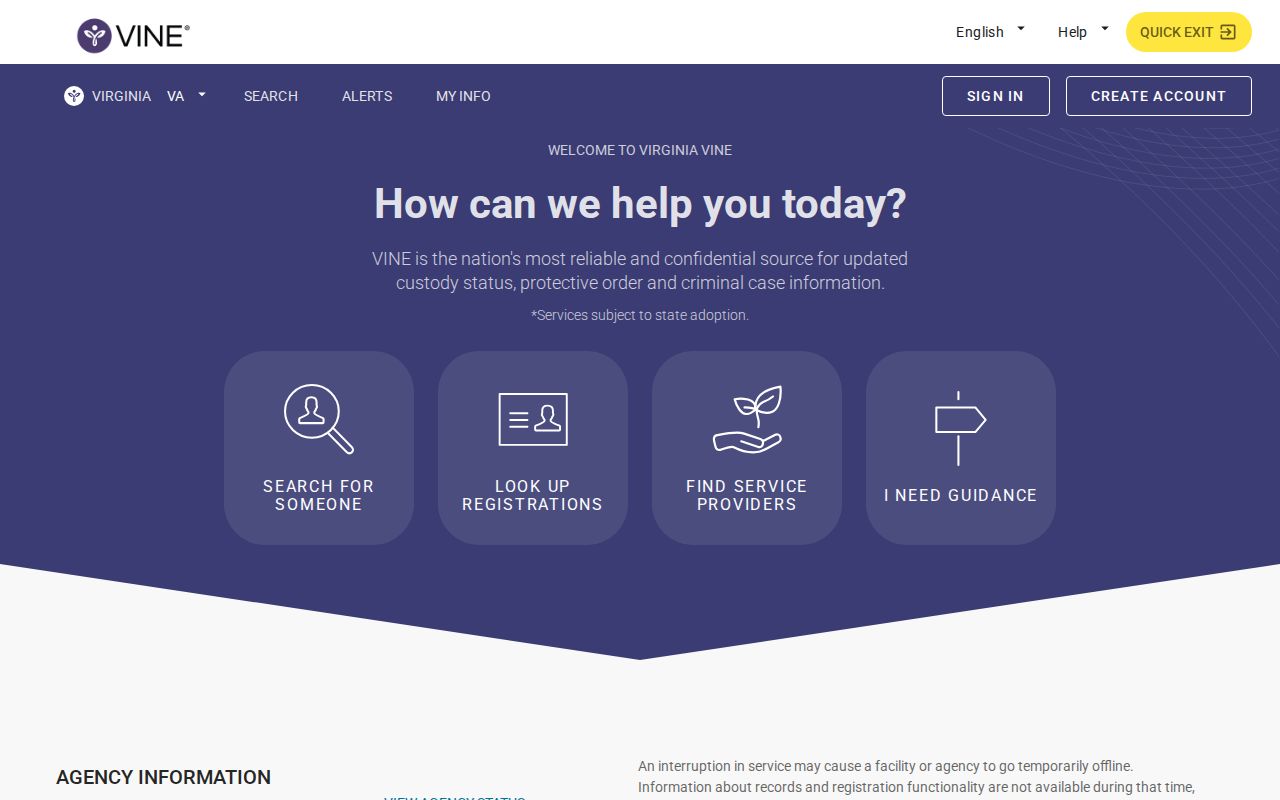
The interface is JavaScript-driven and can evolve. Follow the current labels on the official record instead of relying on a saved image for a live custody decision.
VINE events can include release, escape and recapture, transfer, and death. Work release or home monitoring may also appear depending on the facility. Those categories do not all describe the same result. Work release can change where part of a sentence is served without ending it. A transfer changes the custodian. Record the date, event text, person identifier, and source facility so the notice can be checked against the right agency.
Register Fauquier Release Notifications
Register from the correct inmate record, not from a name-search screen alone. Virginia instructions permit telephone, email, and text channels where the live interface offers them. Each contact route must be entered and confirmed as directed. Save the confirmation so the registration can later be updated or canceled.
- Open the verified Fauquier or NRADC custody record and choose its notification option.
- Select each available delivery method wanted, then enter and confirm the contact destination.
- For telephone notice, create the required four-digit PIN and keep it private.
- Complete any email, text, or on-screen verification shown by the Virginia portal.
- Use the PIN to acknowledge a phone event and retain the registration confirmation.
A VINE call may leave a message and continue calling until the notice is confirmed or 24 hours passes. Calls may display a Louisville 502 area code. Operators at 1-800-467-4943 are available around the clock and can help reset a forgotten PIN or update and cancel contact information. Do not put a PIN or private contact detail into a public records request.
Registration reduces the need to repeat manual checks, but it should not be the only plan. Contact information can change, a message can be missed, and the jail controls the source event. Keep the operator number and the jail contact available. After acknowledgment, write down the event wording and time before calling the custodian. That small record helps avoid confusing a release alert with an earlier transfer or a separate person who has a similar name.
Fauquier Release Alerts Need Follow-Up
Fauquier's official victim and witness guide warns that a person may be released after arrest and provides local jail and magistrate contacts. Virginia's official VINE workflow guidance adds a crucial local-custody distinction: a release or transfer alert can reflect a handoff into VADOC. Together, those sources make a follow-up check essential in Fauquier County.
After an alert, call the jail that sent the event, search the other local or regional custodian, and check VADOC if a state commitment is possible. Use the correct Fauquier court to find the bond, disposition, or sentencing entry. Then request the jail's release or transfer transaction when the exact time, authority, or receiving agency matters. An alert prompts that work; it does not replace it.
VADOC NAAVI Is Separate
Virginia Jail VINE and VADOC NAAVI are not interchangeable. Jail VINE covers participating local and regional jail events. NAAVI is VADOC's separate notification system for eligible registered crime victims in state corrections cases. A person registered with one system is not automatically registered with the other.
NAAVI can provide notices for transfer, anticipated release, a changed anticipated date, actual release from VADOC custody, parole events, escape or recapture, death, and work release when applicable. An anticipated date is a future estimate. VADOC describes advance notice as typically supplied about 30 days ahead and updated if the date changes. An actual-release notice means the person is no longer in VADOC custody, but probation or parole supervision may continue.
The VADOC Inmate and Supervisee Locator provides the public search path for people under state custody or supervision. It is updated daily and may be inaccurate or stale. A state institution result means incarceration continues. A district or supervision context supports release from secure prison but does not prove final discharge from the sentence.
Eligible users who need help with NAAVI can contact VADOC Victim Services at 804-674-3243 or the registration-help line at 1-800-560-4292. The office also publishes victimservices@vadoc.virginia.gov and weekday hours from 8:30 a.m. to 5:00 p.m. These contacts serve state corrections notification. They do not replace the Fauquier jail or regional jail for a local custody event.
Note: Register with NAAVI separately when eligible after a jail-to-VADOC transfer; the prior local VINE registration does not follow the person.
Fauquier VINELink Release Limits
VINELink does not supply a complete Fauquier release record. It may omit the signed court order, exact physical exit time, receiving agency detail, and the full sequence of holds or transfers. Data can lag, and an absent result remains ambiguous. The official evidence hierarchy is straightforward: a roster loss is a clue, an alert is an event notice, a court order is legal authority, and the custodian's release or transfer record documents the physical event.
Federal Bureau of Prisons cases do not belong in jail VINE. Use the BOP Inmate Locator for federal prison custody or release history. Immigration custody uses the ICE locator, while U.S. Marshals pretrial custody may require court or records channels because there is no matching public Marshals locator. The Virginia sex-offender registry is also separate and applies only to people with a registration duty; it is not a general release list.
For the final Fauquier check, match the notice to the correct person, ask the sending jail what event occurred, read the relevant court order, and request the existing release or transfer entry. That method distinguishes community release from a regional, state, federal, medical, or other handoff without overstating what an automated alert proves.
When an agency record and an alert seem to conflict, use the source timestamps and custody scope. A VINE notice can describe the moment the local jail closed its part of the record. VADOC may then show the person under state responsibility after its own update. The two facts can both be correct. Save the event wording and time before contacting the two agencies. The key question is not whether the alert was “wrong,” but which custodian's control ended and which agency, if any, took over next.