
Fauquier Projected Versus Actual Release
A projected date is the agency’s current calculation based on facts known at that point. An actual release is the completed custody transaction. The two can match, but they serve different purposes. VADOC uses several date concepts in official material, including anticipated release, scheduled release, good-time release, and mandatory-parole release. The exact label visible in a live result controls. No safely usable public result was observed during the Fauquier research that justifies renaming a locator field.
A pretrial person has not yet received a final active sentence. Bond may permit release while the case continues, a court may change the terms, or another warrant may prevent exit. A sentenced person has an imposed term, but the active part still must be separated from suspended time and credited prior confinement. The county jail or VADOC then applies the governing credit system. Transfer from Fauquier ADC to Northwestern Regional Adult Detention Center or VADOC is not community release.
The same caution applies to parole. A Virginia Parole Board grant can authorize a path toward release, yet conditions, processing, and detainers remain. A person may also leave a prison and start supervision without being discharged from the sentence.
Find a Fauquier Projected Release Date
The first question is who calculates the date. Fauquier ADC and NRADC handle local confinement records. The sentencing court supplies the legal term and jail-credit decisions. Fauquier General District Court and Fauquier Circuit Court have different criminal roles, so select the court named in the case. VADOC calculates dates for people under its responsibility based on sentence type and active time. Searching the wrong system can turn a missing record into a false claim of release.
- Identify the last known custodian and collect the full name, case number, booking number, or seven-digit DOC ID.
- Read the signed sentencing order for imposed time, suspended time, mandatory minimums, prior-confinement credit, and consecutive or concurrent terms.
- For a county sentence, ask the jail records unit which existing record holds the computed release date and how its earned-credit policy was applied.
- For state custody, search the VADOC Inmate and Supervisee Locator and copy the exact field label, date, DOC ID, status, and update context.
- Check the court docket for later orders and ask whether another warrant, sentence, or detainer affects the calculation.
- Near the date, confirm with the responsible records unit and obtain the completed release or transfer document after the event.
The full county-jail search and records-request chain is also set out on the Fauquier County release records page. It includes the required NRADC transfer check, which should happen before treating disappearance from the local jail as release.
The official VADOC locator shows the state form and the scope of people under custody or supervision.
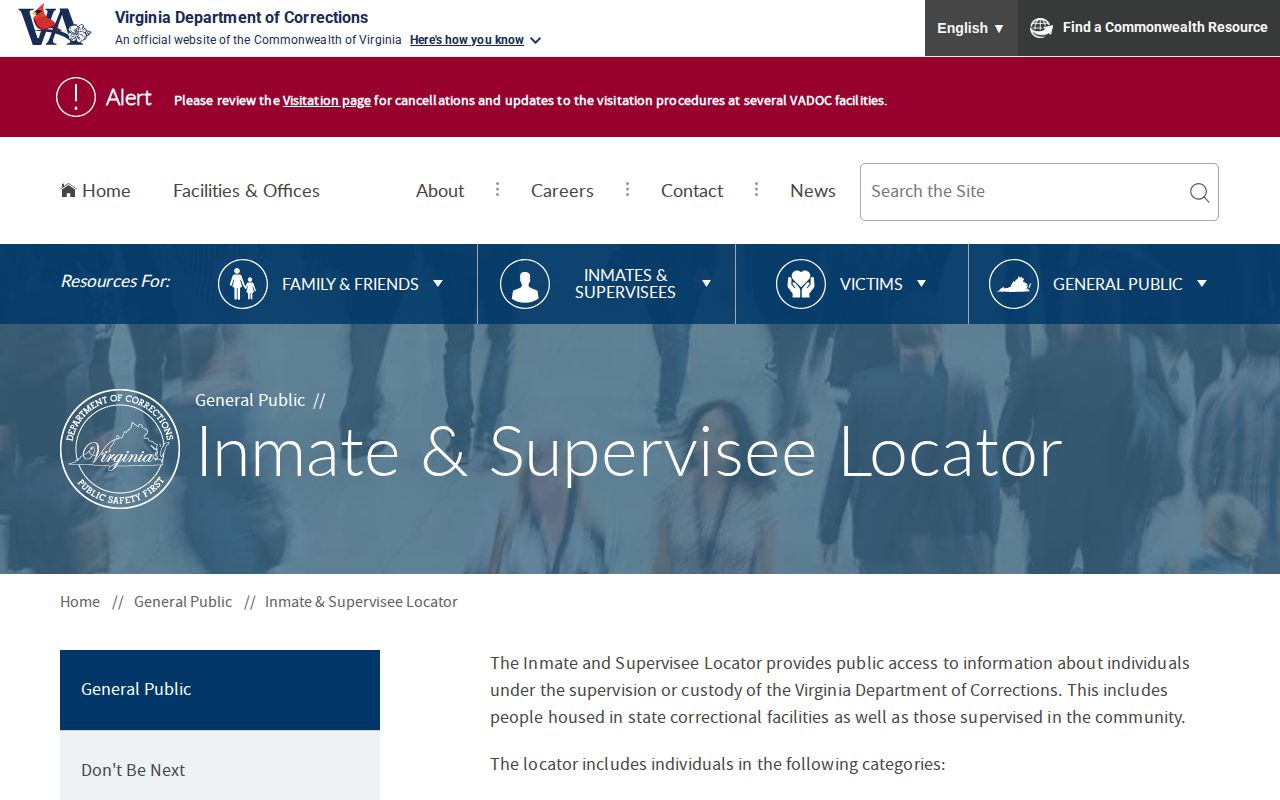
This screen is the state starting point, but a fully discharged person may no longer be within the locator’s advertised current scope.
Fauquier County Jail Date Calculation
Local jail time has its own administration. The court sentence establishes the active term and credits adjudicated by the judge. The jail then maintains the commitment and prisoner records and applies its written earned-credit policy. Virginia Code § 53.1-116 addresses jail records and earned-credit categories. Among its rules, qualifying misdemeanor sentences of twelve months or less can receive one day of credit for each day served when the stated conditions are met and no mandatory minimum controls.
That provision is not a universal half-time formula. Sentence length, offense, mandatory terms, conduct, participation, and the jail’s application to the record all matter. A person housed at NRADC can still have a Fauquier judgment, but the regional custodian holds its own confinement transaction. Ask for the date computation or release screen that already exists rather than requesting staff to create a prediction.
Fauquier’s official jail page also says staff do not give public release dates through the booking-information line. That access limit does not establish that no administrative date record exists. A narrow Virginia FOIA request can seek the nonexempt existing record, while recognizing that exclusions and redactions may apply.
Note: No official Fauquier weekend, holiday, routine gate-time, or date-advancement rule was verified, so none should be assumed.
VADOC Fauquier Release Date Clocks
VADOC separates modern Earned Sentence Credits from older Good Conduct Allowance calculations. For felony offenses committed on or after January 1, 1995, § 53.1-202.2 defines an earned sentence credit as a day deducted for qualifying conduct, program participation, and other requirements. § 53.1-202.3 places listed offenses in a group capped at 4.5 credits for each 30 days served. Other eligible cases use levels of 15, 7.5, 3.5, or zero credits per 30 days.
The familiar “85 percent” phrase is only a broad truth-in-sentencing shorthand. If 4.5 days are earned for each 30 actually served, then 30 days of service satisfy 34.5 days, or about 87 percent, assuming the maximum and no other change. Modern legislation, offense groups, credit levels, and forfeitures make that shorthand unsafe as a personal calculator. Only credits actually awarded belong in an individualized computation.
Older cases follow different clocks. VADOC identifies pre-1995 felonies and certain pre-July 2008 misdemeanors in the Good Conduct Allowance system. Class rates can range from zero to 30 days per 30 served. Qualifying terms may also involve discretionary-parole eligibility, mandatory-parole release, and good-time dates. Those labels must not be blended with modern ESC dates.
The VADOC time-computation page is the official source for which authority computes the sentence and which variables are used.
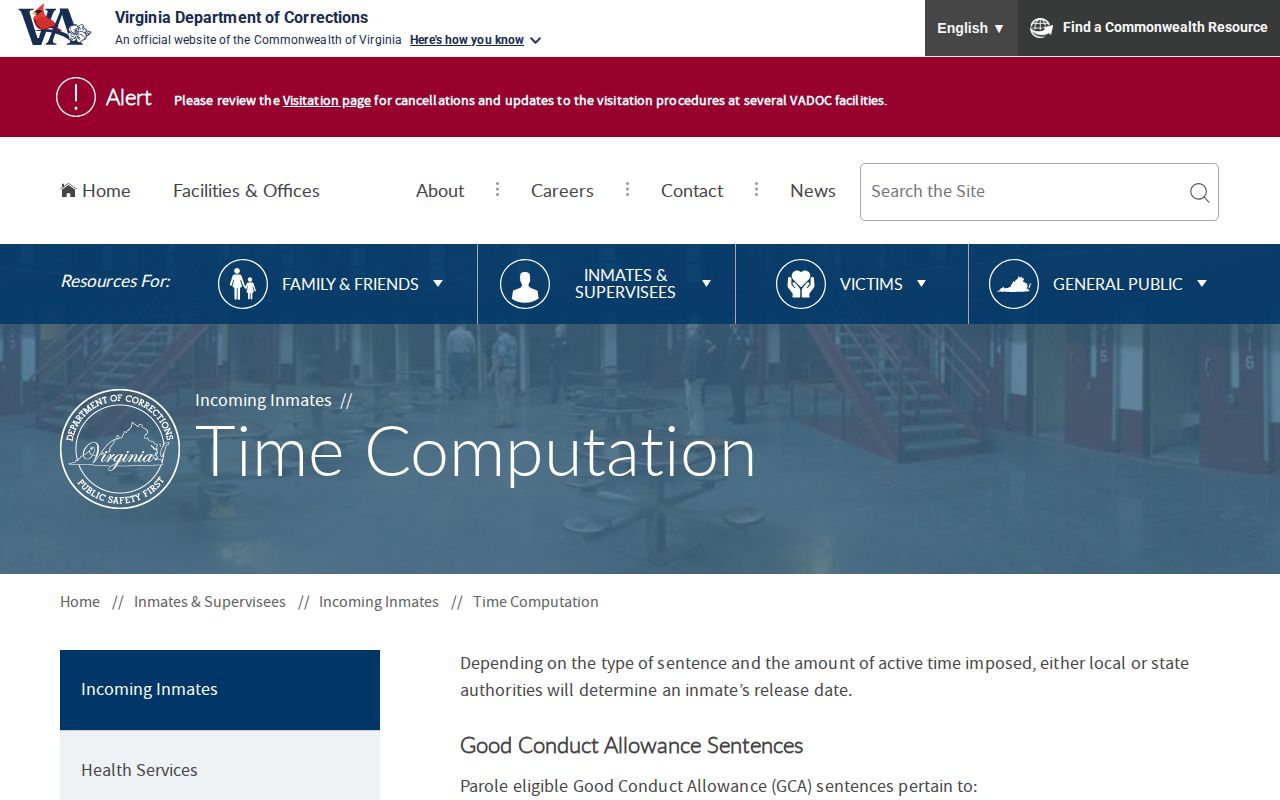
The captured page reinforces that the court term, custody credit, earning regime, and later events must be reconciled by the responsible records staff.
Three Fauquier Release Date Clocks
A Fauquier sentence has at least three clocks. The first is judicial: imposed time, suspended time, a mandatory minimum, and credit for prior confinement. The second is administrative: the credit regime and classification applied by the jail or VADOC. The third is operational: the actual release transaction, including other holds, transport, weather, and signed documents. A court docket rarely exposes every input in the second and third clocks.
A purpose-neutral hypothetical shows why a simple calculator fails. Begin with the active portion of the sentence, not the full imposed term. Subtract only prior-confinement credit awarded in the record. Identify whether local jail credit, modern ESC, or older GCA applies. Count only credits the custodian awarded. Add any valid forfeiture and reconcile consecutive cases or detainers. The result remains tentative until the jail or VADOC confirms it.
Section 53.1-28 gives VADOC limited authority for certain prerelease scheduling and training to discharge a state prisoner within 30 days before ordinary expiration. It does not establish a Fauquier County weekend-release rule and should not be used to move a local jail date.
What Changes Fauquier Release Dates
Any future date should be read with its inputs. A later court order can change active time. A disciplinary finding can affect credit. Another sovereign may be ready to take custody. Parole action can change one eligible sentence path, while a Board grant still does not document a gate exit. The table distinguishes common changes from the records that can confirm them.
| Factor | Possible effect | Best confirming record |
|---|---|---|
| Prior jail credit | Reduces active time when adjudicated and applied | Sentencing order and computation record |
| Earned-credit level | Changes the rate at which days are deducted | Jail or VADOC classification and computation |
| Disciplinary forfeiture | Removes earned credit and moves the date later | Custodian’s disciplinary and calculation record |
| Consecutive sentence | Adds active time from another judgment | All sentencing orders and agency calculation |
| Court modification | Changes the controlling active term | Signed amended order |
| Warrant or detainer | Redirects custody or delays community exit | Hold, warrant, transfer, and release record |
| Parole action | May authorize a conditional release path | Board report, VADOC order, and release transaction |
A release date can also be affected by transport or severe weather at the final operational stage. VADOC says facility discharge or parole release occurs by 11:59 p.m. on the effective date, weather permitting. That is a state-facility rule, not a promised Fauquier ADC exit hour.
Note: A detainer ends one custodian’s control through handoff but may leave the person confined under another authority.
Fauquier Parole Dates Need Context
The Virginia Parole Board decides discretionary parole for people who remain eligible. Monthly decision reports can identify a grant, denial, deferral, or other action. A grant is not an actual release date. VADOC must complete an Order of Release and Conditions of Parole, and a detainer may change where the person goes. The Board’s process also permits suspension or rescission before release.
Virginia Code § 53.1-151 has varied eligibility rules for first and later commitments, life terms, offense categories, and exclusions. Its general first-commitment language cannot be applied without the judgment history. Most modern felony offenses are not eligible for ordinary discretionary parole, while older and statutory exception paths remain. Board action should therefore be matched to the correct DOC number and then checked against VADOC’s actual custody status.
If the locator shows a community-supervision district, that supports physical release from a secure state facility. It does not establish final discharge. The later discharge record marks the end of supervision.
Confirm Fauquier County Actual Release
Near the effective date, check the custodian that holds the person. For Fauquier ADC, call the booking desk only to test current custody, knowing staff do not publish release dates. Check NRADC before concluding the person entered the community. For state custody, use the daily VADOC locator, then seek the signed release documents and actual transaction.
VADOC says a person leaving by discharge or parole reads and signs the applicable Order of Release, Conditions of Probation, or Conditions of Parole and receives a notification-of-release letter. Those records distinguish a completed event from a future calculation. When the person is fully inactive and no longer appears in the locator, VADOC Form 17 is the documented inactive-offender records route.
An alert can add timely notice but remains one evidence layer. Virginia Jail VINE serves participating local and regional jails, while VADOC uses NAAVI for eligible state victim notifications. Registrations do not transfer between them. Instructions for separating a local release or transfer event from a state actual-release notice are on the Fauquier County VINELink Check.
The final evidence chain is short: a future field is an estimate, a Board grant is authorization, a court order is legal authority, and the custodian’s release or transfer record documents what physically happened.