
Understanding Fauquier County Releases
A Fauquier County release ends one custodian's control, but it does not always place the person in the community. The Sheriff's Office Adult Detention Center can release someone on bond, under a court order, after time served, into home or electronic incarceration, or at sentence completion. It can also transfer someone to Northwestern Regional Adult Detention Center, the Virginia Department of Corrections, another jail, or a federal or immigration custodian. Each outcome calls for a different search. A person transferred out is gone from the local jail, yet remains confined.
The record must identify both the event and the next custody state. A current jail phone check cannot do that after the person leaves. Fauquier's booking desk publishes limited facts about people who are still held and expressly does not give the public release dates. NRADC's locator is also current-oriented. The durable trail comes from an existing release or transfer transaction, the order that authorized it, and any later corrections or supervision record. Those sources keep a name from being confused with proof.
- Time served
- The confinement ordered in the case has been satisfied, though probation or another case may remain.
- Discharge
- A formal end to custody or supervision, depending on the record and agency using the term.
- Detainer
- A request or legal basis for another authority to take custody when the first custodian would release the person.
- Parole
- Conditional release from an eligible prison term under rules set through the state parole process.
Fauquier County Release Types
The release label controls where to look next. Bond allows a pending case to continue outside jail under court terms. A dismissal or acquittal can end the case that supported custody, but another charge or hold may still apply. Sentence completion or time served ends the confinement part of that sentence, while probation may begin. Parole applies to an eligible state prisoner and comes with conditions. Home incarceration changes the place and form of confinement. A transfer ends one facility's custody without ending confinement.
| Recorded event | Meaning | Best next check |
|---|---|---|
| Bond or court release | The case remains open outside jail under stated terms. | Court order plus jail release transaction |
| Time served or completion | The active jail term ends; a suspended term or probation may remain. | Sentencing order and custodian record |
| NRADC transfer | Fauquier ADC custody ends, but regional jail custody begins. | NRADC locator and transfer entry |
| VADOC commitment | State corrections assumes custody after a qualifying sentence. | VADOC locator and state record |
| Detainer handoff | Another authority may take custody at the local exit. | Receiving agency plus jail transfer record |
A death in custody is not a community release. Nor is a move into work release necessarily a discharge. Northwestern Regional Community Corrections placement can remain part of the sentence. Always retain the agency's own event wording and ask what custodian, if any, received the person.
Fauquier County Release Record Fields
A sound Fauquier County release packet ties one identified person to one confinement episode. Ask for existing records, not a custom explanation. The useful set may include the booking sheet, commitment and bond changes, release screen or log, release order, and transfer entry. Some parts may be withheld or redacted, but a narrow request makes it easier to separate releasable administrative facts from protected material.
| Field or document | What it establishes |
|---|---|
| Full name and booking or inmate ID | Links the event to the correct person and custody episode. |
| Admission date and time | Defines the start of the jail stay being researched. |
| Release date and time | Records when that custodian's control ended. |
| Release type or authority | Distinguishes bond, court order, time served, completion, transfer, or detainer. |
| Destination or receiving agency | Shows whether the person entered the community or another custody system, when disclosable. |
| Court, charge, and case number | Connects the administrative exit to the legal proceeding. |
Can a court result replace the jail record? No. The court order supplies the legal reason, while the jail transaction records the physical release or transfer. Use both when the exact outcome matters.
Request Fauquier County Release Records
Fauquier Sheriff, ADC, and emergency-communications requests go through the Sheriff's Professional Standards Division. Send a focused request by email to sheriff.FOIA@fauquiercounty.gov, by mail or in person at 78 West Lee Street, Warrenton, VA 20186, or by phone at 540-422-8600. Published closing times differ between official pages, so call before an in-person visit. If NRADC created the record, use the NRADC FOIA route as a separate request.
- Identify the person with full name, booking or inmate number, approximate booking date, and case number when known.
- Ask for the existing booking record and the release or transfer transaction, including date, time, recorded type, authority, and destination if disclosable.
- Request electronic, segregable nonexempt portions and accept redaction of protected details.
- Ask for an itemized estimate before the agency incurs costs above a limit you choose.
- If the response points to another custodian, send that office a new request for its own transaction.
Virginia FOIA generally calls for an agency response within five working days. A response may produce records, withhold them with legal authority, produce part, report no responsive records, redirect the request, or invoke more time. Charges may cover reasonable actual costs. No fixed Fauquier release-record fee was verified. The statute does not require a public body to create a list or analysis that does not already exist.
Virginia Law on Fauquier Releases
Virginia Code § 2.2-3704 sets the general public-record request process. Section 2.2-3704.01 requires release of nonexcluded portions when protected content can be separated. Public-safety and criminal-investigative provisions can limit some material, and juvenile, victim, medical, personal, sealed, expunged, security, and investigative facts may not be public. A booking desk's refusal to give a release date by phone does not decide whether an existing administrative record has a releasable portion.
Fauquier does not publish a released roster or a verified retention window for such a roster. Formal jail records and court files are the archival route. Fauquier's expungement page currently describes qualifying relief and says an expunged record is sealed from public access rather than destroyed. Virginia law changes in this area on December 1, 2026. Check the statute and court forms in effect on the filing date. A public search absence after sealing does not prove the custody episode never occurred.
Important: Ask for the release transaction separately from investigative reports. Narrow records are easier to identify, review, redact, and produce.
Bonding a Fauquier County Release
Fauquier publishes round-the-clock bonding procedures even though it does not publish release dates. Cash may be posted through the magistrate or court. Property bond requirements come from the magistrate. A private bondsman may also be used, but Sheriff's Office employees cannot recommend one. These channels address the bond requirement, not the time when all release checks will finish.
A bond exit is pretrial release. It is not an acquittal, dismissal, sentence discharge, or finding of guilt. Fauquier Adult Court Services can investigate and supervise some pretrial releases, so the person may leave the cell while remaining subject to the pending case and court terms. Confirm the bond order in the proper court, then obtain the jail's release transaction. Another warrant or detainer can still redirect the planned exit.
Note: The official source does not publish a gate, waiting point, routine release hour, or weekend schedule for family pickup.
Fauquier County Custody Movement
The Sheriff's 2024 Annual Report records 1,260 people booked and 3,537 trip transports. These are movement and booking measures, not a release count. They cannot support a claim that the same number of people entered the community. The figures do show why a current-only snapshot misses much of the year's jail activity.
Transfers can account for part of that movement. A person may vanish from the Warrenton jail check because Fauquier uses NRADC for overcrowding, medical needs, or security reasons. The receiving-facility check comes before any conclusion about release.
Find Fauquier County Released Inmates
Begin with the last known custodian. Build a careful identity set with the legal name, known variants, booking or DOC number, approximate admission date, and court. A name alone is not enough. The Fauquier ADC booking desk at 540-422-8700 can confirm limited current-custody facts. A current match means the person remains there. A nonmatch means only that the first check did not confirm present Fauquier ADC custody.
- Call Fauquier ADC, then search or call NRADC because an official transfer is a common alternative to local release.
- Search VADOC when a felony sentence or state transfer may apply. Read the location, supervision context, update date, and release-date label exactly.
- Use local Jail VINE for participating-jail custody events. Use VADOC NAAVI separately for eligible state-custody notifications.
- Search the correct Fauquier court for the bond, disposition, sentence, or order that supplied legal authority.
- Request the release or transfer transaction from the custodian that last held the person.
- Use BOP, ICE, or a federal court only when the known custody path makes those systems relevant.
Important: A roster disappearance is a clue, not a release record. Check NRADC and VADOC before treating the person as back in the community.
A same-day release-log request can cover everyone in a defined time window. A named-person search should continue through the full custody chain above.
VADOC Fauquier Release Search
The VADOC Inmate and Supervisee Locator covers people under Virginia corrections custody or community supervision. It is not a Fauquier booking archive. Use the seven-digit DOC number when known. Otherwise, enter at least the first three letters of the first name and the full last name. Advanced filters can narrow common-name results, but they do not prove identity.
| Search input or result | How to use it |
|---|---|
| DOC number | Best direct identifier when the seven-digit number is known. |
| First and last name | Use the required name characters, then compare all available descriptors. |
| Location or supervision context | Separates an institution from a community-supervision district. |
| Release-date field | Preserve the live label; never call a future date an actual release. |
| Daily update and disclaimer | Record the date checked and confirm important facts with VADOC. |
The official locator screenshot shows the state search entry point and its released-person context. Review the live VADOC locator before relying on any result.
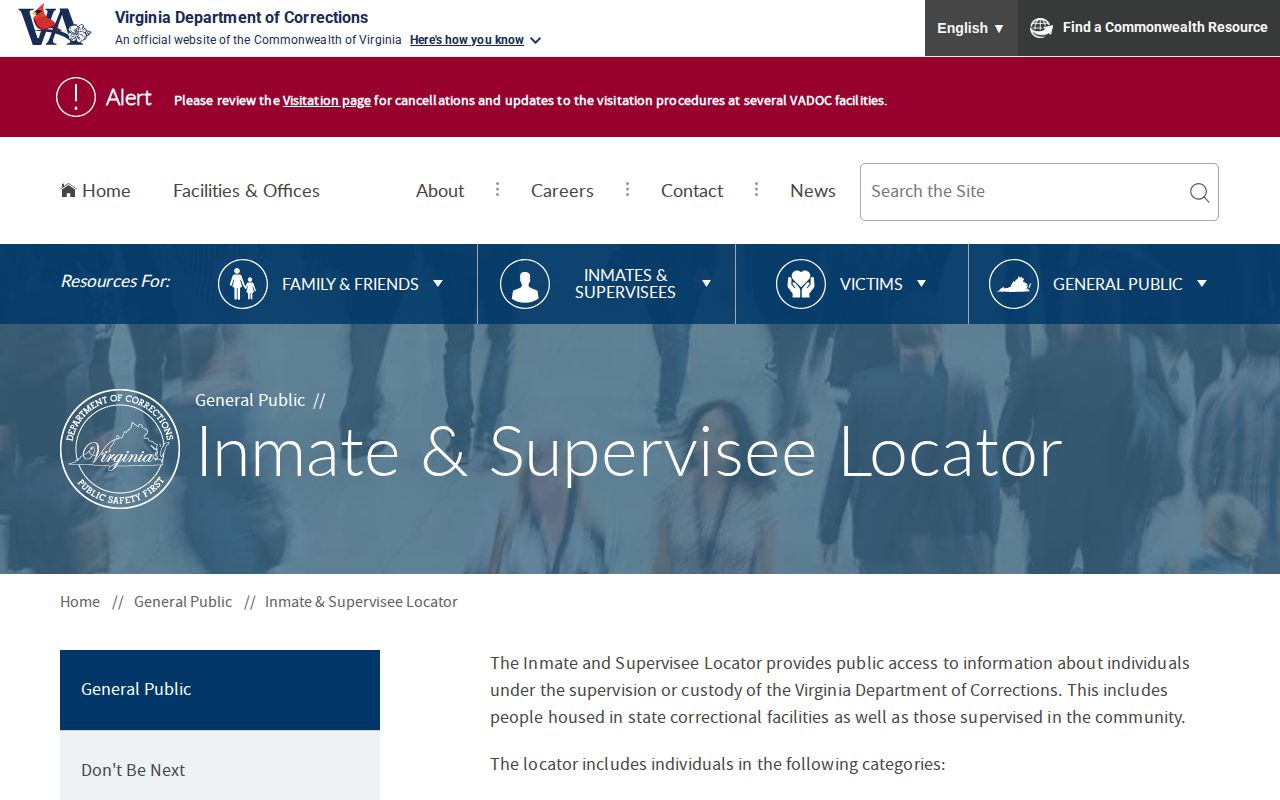
A community-supervision result supports physical release from a state institution, but supervision may still continue. A fully discharged person may later leave the locator's current scope. For inactive records, VADOC Form 17 and the agency FOIA route are the fallback.
Fauquier Release Court Layers
Fauquier requires three systems to be kept apart. General District Court handles misdemeanors, traffic cases, preliminary felony steps, arraignments, and early bond events. Circuit Court handles felony trials, final felony dispositions, and appeals. Adult Court Services handles local or pretrial supervision within its authority. VADOC handles state felony custody and community supervision. The court of jurisdiction named by the jail tells you where to start.
Use the Virginia Judiciary portals to read charges, hearings, disposition, sentence, probation, and docket entries. Fauquier's Circuit Court search covers 1988 forward, but the signed order itself may require clerk inspection or a copy request. Juvenile and Domestic Relations District Court information is not publicly searchable online. Do not force a juvenile matter through the adult portals.
A disposition can explain why custody should end. It rarely supplies the exact gate time. Read the active term, suspended portion, jail credit, consecutive or concurrent structure, and probation. Then match the signed order to the jail's administrative exit record.
When Fauquier County Releases Happen
The Adult Detention Center publishes 24-hour bonding, but it does not publish routine release times, a public exit door, a family waiting area, or weekend and holiday timing. It also refuses to give public release dates by phone. Those gaps must remain gaps. A caller can ask the records or booking staff which official channel can confirm an already completed event, but should not expect a gate-time forecast from the public page.
The ADC separately lists an accounts contact for release of funds. That does not establish when the person left. Likewise, a court order, completed bond, or alert can precede final checks for other warrants, detainers, or receiving agencies. When pickup logistics matter, obtain instructions from the facility tied to the specific person and event rather than relying on standard jail practices from another locality.
Note: No official Fauquier family pickup point, routine gate time, or local transit promise was verified in the source sweep.
Documents After a Fauquier Release
Fauquier ADC warns senders not to mail original birth certificates, driver licenses, Social Security cards, green cards, or other key papers because originals will not be returned. That local rule matters after release, when a person may need identity papers for ordinary life and supervision tasks. Virginia DMV publishes accepted-document guidance and a current replacement-ID process. Its list includes a Virginia criminal-justice-agency offender-information form among possible documents.
The correct route depends on which paper is missing. Start with the issuing agency. Do not send irreplaceable originals to the jail. If a corrections or supervision office can supply an accepted form, confirm the current DMV document list before visiting. Costs and proof rules can change, so use the live DMV instructions rather than a saved fee or checklist.
This need is separate from release verification. A replacement document helps establish identity, while the custodian's transaction establishes when and how jail control ended.
Fauquier Release Support and Supervision
Fauquier ADC identifies Encompass Community Supports for mental-health counseling and group therapy. It also lists substance-use programs and medically assisted treatment for screened participants with an after-release focus. Virginia law provides a discharge-planning and service-linkage framework for some people with serious mental illness. These services do not prove release, but they can form part of a transition plan.
Probation and parole are different from treatment. Probation is imposed by a court, often instead of or after confinement. Parole is conditional release for a person who remains legally eligible under Virginia law. VADOC Community Corrections supervises state probationers and parolees, while the Virginia Parole Board makes parole decisions. A Board grant authorizes a path; it does not prove the person crossed the gate. Verify actual release and continuing supervision separately.
Compare the supervising agency, court order, locator context, and discharge record before treating release from a cell as the end of all legal control.
Fauquier Release Alerts and Custodians
Virginia Jail VINE covers participating local and regional jails. It can provide custody events and allow notification registration, but an alert is not the complete court or release file. A local event may describe release or transfer. If the person then appears in VADOC, the event was a handoff into state custody rather than return to the community. Eligible state-custody notifications use VADOC NAAVI, which is separate from jail VINE.
Federal and immigration records cover different populations. The BOP locator can show historical federal custody, often with a release date and a no-longer-in-BOP status. It has no Fauquier jail bookings. ICE's Online Detainee Locator is current and short-lived after release, not a permanent release archive. The U.S. Marshals Service manages some federal pretrial detention and transport but offers no comparable public historical locator.
Evidence has levels. A future date is an estimate. An automated alert reports an event. A Board grant is authorization. A court order states legal authority. The custodian's release or transfer record documents the physical custody transaction.
ICE Handoffs After Fauquier Release
An ICE detainer can change the destination of an ordinary county release. The request asks the local custodian for notice and an opportunity for ICE to assume custody, with a hold of up to 48 hours beyond the time the person would otherwise be released. A detainer alone does not prove ICE completed the pickup. The jail's transfer record and the receiving custodian's result must show what occurred.
No Fauquier ICE detention-services contract was verified. The ADC should not be described as an ICE facility. When an individual detainer is documented, check the ICE Online Detainee Locator and the county release transaction. Loss of an ICE result later is also inconclusive because ODLS is not a durable history. Court or agency records are the long-term route.
Mail After a Fauquier Release
Fauquier has a distinctive after-release service for scanned mail. A former inmate can call 1-800-729-0644 and provide the full name, FCAD name, inmate ID, and return email. After verification, the scans are sent by email. This can help recover mail that arrived through the jail's system after the person left.
The service is not a released-inmate lookup. Verification for the mail process does not publish the release date, legal authority, or next custodian. Keep that practical service separate from the evidence needed to confirm a custody event. Use the jail release record and court order for the latter.
Where Fauquier Release Records Appear
The right system depends on the last custodian and the question being asked. A live roster or phone check answers who is held now. An administrative record answers how one jail episode ended. State and federal locators answer only for their own custody populations.
| System | Who it covers | What absence or presence means |
|---|---|---|
| Fauquier ADC phone check | People currently held at the county ADC | A match confirms current local custody; no match does not prove release. |
| NRADC locator | Current regional-jail custody | A match can explain transfer from Warrenton; no match still needs records. |
| Jail release or transfer record | One custodian's completed transaction | Records date, type, authority, and possible destination. |
| VADOC locator | State custody or community supervision | Institution and supervisee results have different meanings. |
| Court case | Legal proceeding and orders | Shows authority and disposition, not always physical exit time. |
| BOP or ICE locator | Federal prison or immigration custody | Custodian-specific only; another authority may still hold the person. |
Fauquier County Release Facilities
Three operating adult facilities belong in the Fauquier custody map. The historic Old Fauquier County Jail is a museum, not a search location. No operating VADOC prison, federal prison, or dedicated ICE detention facility was identified inside the county.
- Fauquier County Sheriff's Office Adult Detention Center is the local booking point in Warrenton and can release, transfer, or place a person under another lawful arrangement.
- Northwestern Regional Adult Detention Center serves Fauquier and can receive county transfers for population, medical, or security reasons.
- NRADC Community Corrections Division administers work release and advance commitment; placement there can remain part of the sentence.
When a person is not found at the Warrenton ADC, check the regional jail before assuming release. If a felony commitment moved the person to Virginia corrections, use VADOC. If the record names a different receiving agency, follow that agency's custody system.